


2026 Tenant & Housing Justice Giving Project
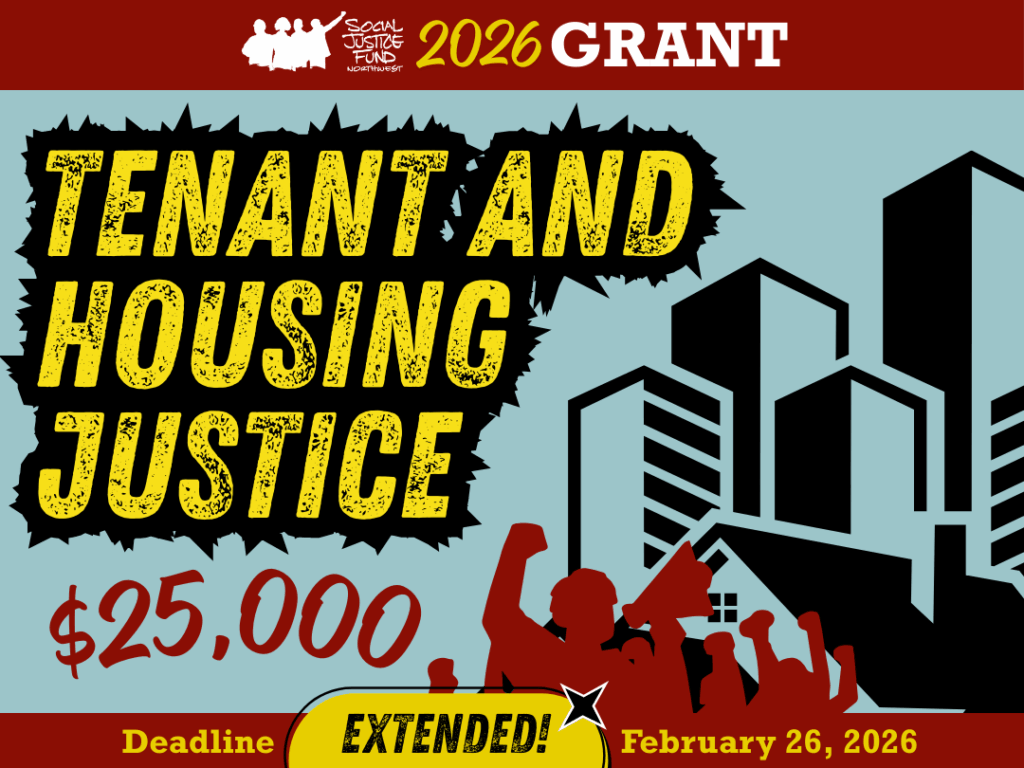
The 2026 Giving Project will focus on Tenant and Housing Justice, funding movements led by those most impacted by our current housing crisis in the Pacific Northwest and Mountain West.
This Giving Project will make grants to support community organizing work that builds collective power among renters, homeless folks, unhoused folks, and/or homeowners (bank tenants) to create dignified, affordable, safe, and healthy homes for all.
Check out the Informational Session recording here.
Apply to join the Tenant & Housing Justice Giving Project:
Application for BIPOC folks
Application for white folks
This grant cycle seeks to support organizations working to undo and/or create alternative solutions to exploitative housing systems which were built and are sustained by capitalism, colonialism, classism, racism, xenophobia, and ableism. For SJF’s definition of community organizing, please click here.
Tenant and Housing Justice community organizing work can include, but is not limited to:
- Collective power building among tenants to dismantle and push against the current oppressive housing systems and structures
- Examples: rental and utilities assistance, tenants’ rights training, eviction prevention and intervention, etc.
- Local and statewide tenant and housing systems/policy change
- Tenant leadership development
- Creating collective, cooperative housing structures
- Re-entry organizing by and for folks who were recently incarcerated to provide housing and resources, influence and set policy, etc.
- Disability justice organizing focused on affordable, accessible, and supportive housing for disabled folks and elders
- Survivor-led organizing for people transitioning out of abusive situations
In 2026, our in-person Giving Project will be based in Seattle. It will start in January and focus on funding grassroots organizing in our five-state region: Idaho, Montana, Oregon, Washington, and Wyoming.
If you have any questions please email us at [email protected].
What is a Giving Project?
Giving Projects are a unique, participatory model of funding that provides significant financial resources to grassroots organizing for long-term progressive social change. Giving Projects bring together a diverse group of people of varied class identities who are passionate about social change and want to strengthen their skills in fundraising, grantmaking, and community building. Participants work together to deepen their understanding of social justice principles and engage in collective giving and fundraising to support grassroots organizations.
- Cohorts consist of a cross-class, multiracial group of approximately 20 volunteers who commit to the entire process.
- Each person makes a meaningful gift — whatever that means for you.
- We develop a shared analysis of race, class, and the justice area of this Giving Project through workshops and trainings.
- Each person commits to fundraising within their community, including friends and family. Social Justice Fund staff will train you in grassroots fundraising and support you along the way through regular 1:1 coaching sessions.
- Participants will be trained on Social Justice Fund’s democratic grantmaking process. You will read and score proposals, make collective decisions, and grant money to some of the most inspiring, effective social change work in the region.
All Giving Projects follow roughly the same process:
- Community building, including personal storytelling and setting personal & collective goals.
- Political education about racism, classism, and the grantmaking issue area for the project.
- Fundraising training focused on grassroots fundraising skills and learning how to make an ask.
- Grantmaking training about social justice philanthropy, SJF’s grantmaking criteria, and decision-making processes.
- Ongoing fundraising with support from SJF staff and other Giving Project members.
- Reading and scoring grant applications.
- Collective decision-making process to decide together which organizations will receive grants.
What types of organizing do Giving Projects fund?
The Giving Project participants will use Social Justice Fund’s grantmaking criteria to select grantees. We fund grassroots community organizing led by the people most impacted by injustice and working for systemic change. Giving Projects fund organizations throughout SJF’s funding region: Idaho, Montana, Oregon, Washington, and Wyoming.
More specifically, we give grants to groups that:
- Are led by the people most directly affected by the issues the organization is working on
- Continually build leadership from within their own membership, base, or community
- Work to understand and address the root causes of the issues, not just the symptoms
- Bring people together to build power they wouldn’t have individually
- Use that power to create systemic change, which includes altering unjust power relations
- See themselves as part of a larger movement for social change, and works towards strengthening that movement
Giving Project COVID-19 Protocols
As an organization committed to accessibility, SJF recognizes our role in mitigating the spread of airborne viruses like COVID-19 and we aim to take all possible actions towards hosting COVID-safer public events, including our GP.
Here are the protocols that we will be following during the entirety of the GP:
(1) Well-fitting masks/respirators such as a KN95, KF94, or N95 will be required for all participants to wear when not eating or drinking. SJF will provide adequate respirators for all participants.
(2) Air purification will be provided, either through HEPA filtration via the venue or portable air purifiers adequate for the square footage of the meeting space, provided by SJF.
(3) Participants will be asked to take a rapid COVID-19 test at home before entering each session. SJF will provide rapid tests for all participants. If their rapid test is positive, participants will inform facilitators who will offer alternative ways to engage in session programming.
(4) If sick or feeling any symptoms of illness, participants are required to stay home and will be offered alternative ways to engage in session content.
Schedule (All meetings will be in person unless otherwise noted below. Food will be provided at each in person evening session.)
Session 1
Introductions (In person)
Saturday, January 24 10 a.m. – 5 p.m. PT (1 hour lunch break – breakfast and lunch provided)
Session 2
Justice area orientation with guest speakers (Zoom)
Wednesday, January 28 6–8 p.m. PT / 7–9 p.m. MT
Session 3
Racial justice & class analysis workshop, part 1 (In person)
Saturday, February 7 10 a.m. – 5 p.m. PT (1 hour lunch break – breakfast and lunch provided)
Session 4
Racial justice & class analysis workshop, part 2 (In person)
Sunday, February 8 10 a.m. – 3 p.m. PT (1 hour lunch break – breakfast and lunch provided)
Session 5
Fundraising training, part 1 (In person)
Wednesday, February 25 5:45 p.m. – 9 p.m. PT
Session 6
Fundraising training, part 2 (Zoom)
Wednesday, March 4 6 p.m. – 9 p.m. PT / 7–10 p.m. MT
Session 7
Justice area guest speakers/grantee panel (Zoom)
Wednesday, March 18 6 p.m. – 9 p.m. PT / 7–10 p.m. MT
Session 8
Grantmaking training (Zoom)
Wednesday, April 1 6–9 p.m. PT / 7–10 p.m. MT
Session 9
Grant reading/scoring & cohort support
Wednesday, April 22 6–9 p.m. PT / 7–10 p.m. MT
Session 10
Collective decision making training (In person)
Wednesday, May 6 5:45 p.m. – 9 p.m. PT
Session 11
Fundraising support & continued training
Wednesday, May 27 6–9 p.m. PT / 7–10 p.m. MT
Session 12
Decision Making Day #1 (In person)
Saturday, June 27 10 a.m. – 5 p.m. PT (1 hour lunch break – breakfast and lunch provided)
Session 13
Decision Making Day #2 (In person)
Sunday, June 28 10 a.m. – 3 p.m. PT (1 hour lunch break – breakfast and lunch provided)
Session 14
Decision Making Day #3 (Zoom)
Wednesday, July 1 6–9 p.m. PT / 7–10 p.m. MT
Session 15
Celebration! (In person)
Saturday, July 11 1–3 p.m. PT